
March is upon us and I have just been given our launch date for Nausikaa which is to be Friday April 17th, weather permitting. In boatyards across the nation the work rate will be rising in order to prepare yachts for the season ahead. Hull washing and antifouling at the very least but also routine maintenance, and sometimes not so routine repairs and husbandry. For wooden boats, the work can be enjoyable enough if all is planned and plenty time is available to complete the task list. Happily, Nausikaa has spent the winter under cover with the mast unstepped (taken off) in the shed with the doors closed at Traditional Sail -Justin Soole’s wooden shipwright business at Lincombe Yard in the Salcombe / Kingsbridge estuary. To be under cover like this is obviously a joy as it means that work can proceed in all weather conditions. This winter has been a record breaker for rain and it will be creating much stress for those who have been trying to complete work outside. Even being under cover but with sides open to the weather (as was the case when in previous years we wintered at Baltic Wharf in Totnes), can be problematic with both the cold and the humidity making life difficult for the would be yacht maintainer.
At the end of the last season I had given myself quite an ambitious list of ‘winter work’ and generally much more than I would usually undertake. Ambitious considering that I am not fully retired and do still have a job to attend to, and the arrangement at Traditional Sail being that I can only access the yacht on weekdays. Therefore my routine has been to work, often after a hearty breakfast, for a few hours each weekday. Starting in mid November, I wanted everything to be completed by early March.
Below Deck Improvements
It has been thirteen years since the major refit in 2012 and a number of minor deteriorations had taken place inside in the cabin area.
- The white paint on the deckhead and the internal bulkheads was just beginning to flake.
- In 2020, as a consequence of the Covid 19 pandemic lockdown the yacht was significantly late into the water and the carvel hull planks had dried out more than normal. On launching leaks occurred in new and unusual places giving rise to some brown stains in the lockers.
- Movement around the mahogany locker doors had made opening and closing, in most cases, troublesome.
- Expansion of the oak sole planking had reached the point where it was not possible, in some places, to access the bilges.
- The bilges could benefit from a repaint.
Happily all the above has been completed and here follows a list of the paint I used:
- For the white deckhead and matching bulkheads – Wimborne White in modern eggshell by Farrow and Ball .
- For the lockers – Damboline in White by International
- For the bilge – Red Bilge and Locker Paint by Teamac
- The soles were also revarnished using my go to yacht varnish Schooner by International.
New Cushions
The fitted cushions no doubt also dated from 2012 and they needed replacing. Happily for me, I can call upon the services of Pepe Garden Furniture and Emma, our seamstress in the cushion department, has risen to the challenge of making me new cushions using the old ones as templates. The fabric, being the same fabric that we use for garden furniture, is perfectly suitable.
Brightwork
On a wooden yacht this means the clear finished wood that is varnished. This provides protection from UV and from the weather but its main purpose is to show off the hours of dedication that has gone into maintaining it! As it turns out, I now find the business of ‘doing the brightwork’ somewhat therapeutic, but I confess that when I started I found the whole subject thoroughly intimidating. I intend to write a separate post about my journey and adventures in brightwork, but here it is enough to say that every area of clear woodwork on the yacht that is exposed to the weather, needs to be distressed and a coat of varnish applied, in my opinion, without fail every year. Hence this is what has happened once again this year. I use Schooner from International everywhere as referenced above. Before moving on thanks and due credit to Justin Soole at Traditional Sail for his willingness to share his knowledge and experience and for his words of encouragement.
- Yacht varnish – Schooner by International.
- Gold Lettering – Epifanes Gold Special
Repaint Deck
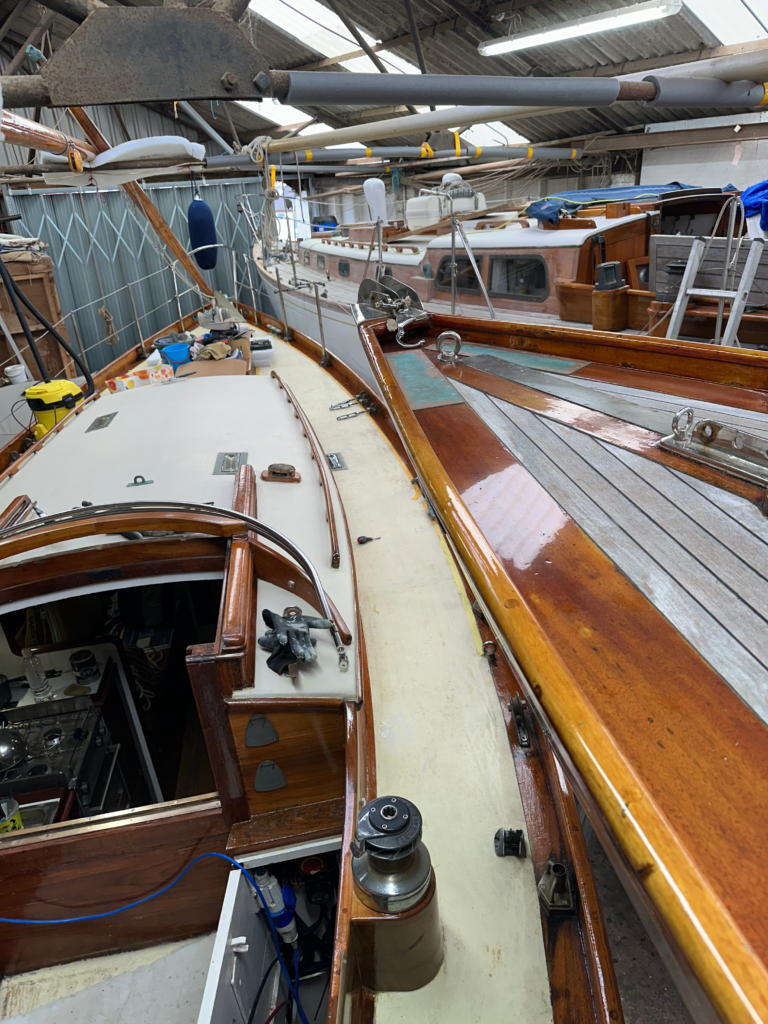
Pic shows the new deck paint on the coachroof and the old colour . Bojar‘s bow is overlapping.
The deck probably did over ten years before repainting, or maybe I am wrong. In any case, last year I repainted the deck with Teamac buttermilk deck paint. It had quite a lot of non slip grit in it, but to be honest, it was more yellow in colour than I expected and I never really liked it, although it would probably look good on a trawler. Hence this year I have repainted the deck in International Interdeck Non Slip Deck Paint in beige, which is exactly the colour it was at refit and I like it. It doesn’t have grit in it, but it is lovely – a shame to walk on it really.
- Deck Paint – International Interdeck Non Slip in beige
Rigging
I have an issue with the the starboard spreader that is regularly tearing the headsail – to be investigated.
I have an issue in that when the weight of the boom is being held by the topping lift the main halyard is interfered with at the top of the mast making hoisting the mainsail difficult. As a workaround we have been dropping the boom onto the coach roof in order to hoist the mainsail. To be investigated.
Sail Repairs
Apart from a repair to the headsail as the result of spreader damage (see above) , I have also arranged for a repair to the cockpit spray hood, and new mainsail batons fitted with two holes on the end.
- Sailmaker of choice and highly regarded – Dart Sails and Covers
Marine Engineering
As Nausikaa lives inside a shed in the winter the winterisation of her engine is less crucial than if she were outside. Nevertheless, I like my engine to be looked at, serviced even, by a professional every year, along with other aspects of marine engineering. This despite me being, in a previous life, an Engineer Officer in the Royal Navy Submarine Service.
This year we shall also be replacing two sea cocks in the heads, which, as above, I really should do myself but I am not going to. I may however rise to the challenge of replacing the sacrificial anode on the back of the propeller.
Of course marine engineers who fix yachts earn all of their money in the winter and are inevitably very busy when you want them. If they will not turn up until the very last day they can possibly turn up, and then discover something bad, there is a risk that plans will have to change.
Antifouling
I don’t like doing this job because I know I will get it all over myself so once again I am going to ask the boatyard to do it. The antifouling goes on last, shortly before launch, so that its special anti fouling properties are maintained. The aqua marine green colour that I use on Nausikaa is generally hard to source, unless you have these details:
- Anti fouling – NAUTIX A3 YACHTING RAL6033 GREEN ANTIFOULING 2.5L
- Supplied direct from Nautix UK distributor – www.marineware.com
The yacht needs two pots of the above = five litres .
Coming out of the shed at Traditional Sail, Lincombe Boatyard April 2025